


Khaji Khaji Oma Khaji
- Hannah Larson
- Dec 29, 2019
- 4 min read
Updated: Jan 1, 2020
The Christmas carolers called to say they were delayed by an hour due to traffic from a CAA-NRC protest. After hearing the amount of time, I slumped back into a chair in our living room - the room we had been busy preparing all day for twenty or more carolers. The ping-pong table had been folded, our long bench moved aside, and the space was now centered around the lighted Christmas tree my family built together out of books that same morning.
We were all gathered downstairs admiring our work and prepared to greet our friends and family in the caroling troupe. I still do not remember who suggested it or why it even happened, but suddenly Saurabh, Adarsh, and Auntie disappeared upstairs and returned with arms-full of Bodo fabrics. Seconds later a flute in a beautiful Bodo Christmas song began to play. Saurabh quickly fitted Adarsh with the green cloth around his legs and head, and then he caught the beat of the drum and began to dance. Adarsh stepped in alongside Saurabh, and Auntie soon followed.
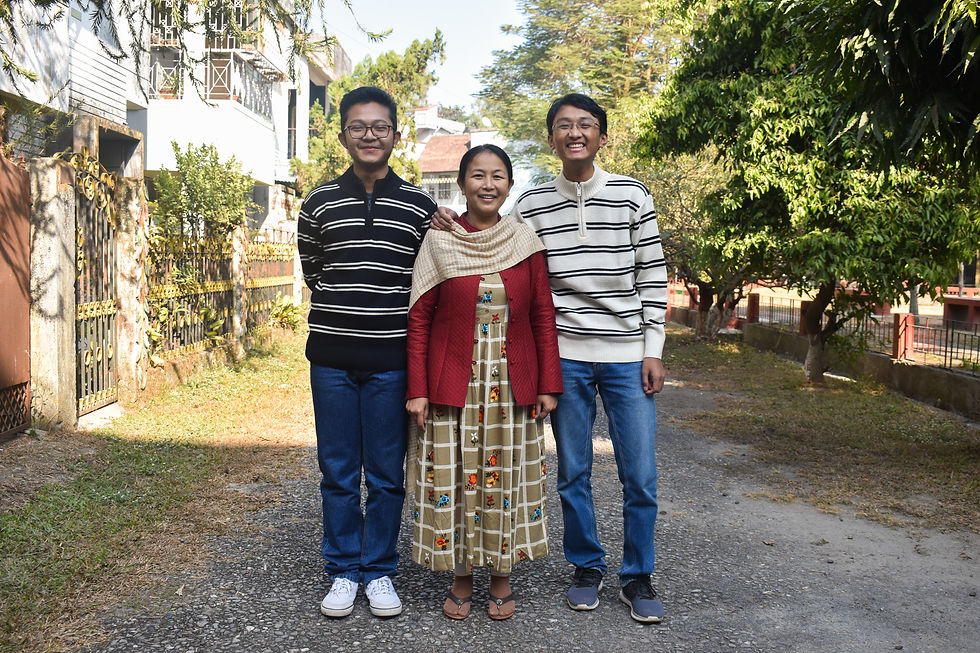
In the soft color of our Christmas lights, I watched all three of them grip their cultural patterns with pride as they laughed and danced around the room. The movements were strong and repetitive - interrupted only as Adarsh's fabric kept hilariously unraveling as he danced. I tried to follow Auntie for the woman's dance but I most definitely did not look as womanly as hoped. Halfway through the song, all four of them started laughing and laughing about something I did not understand. Only after we stopped dancing did I learn that the whole chorus of this Christmas song was about how to prepare the Bodo pork dish called Oma Khaji.

That was the night before Christmas. But the Christmas festivities started more than a week earlier in Kolkata at the MCC Guest House. Seorin and I were blessed with an entire week to spend in the big city and pretend like we had never left our home countries. We watched Frozen 2 in theaters, ordered Starbucks holiday drinks, made Christmas cookies, and sang familiar carols with MCC staff for morning devotion. Halfway through the week, Seorin’s mother came to visit from South Korea. She showered MCC with gifts from Korea, excitedly bought kurtis and Kashmir shawls from New Market, and lovingly worried about me spending Christmas away from my family in the United States.
The week away from our host families ended with the annual MCC Christmas party. MCC India staff and their families arrived at the heavily decorated MCC office in their special sarees and kurtis, hot chai and cookies were offered, and everyone was strongly encouraged to get up and perform something. Daughters danced, sons played guitar and led trivia questions, and MCC staff collaborated to sing songs and perform magic tricks. It was a long and energetic night that ended with several of us rushing off to sleep before our 10k run early the next morning.

As we gathered to celebrate the birth of Jesus, recounting the story of the innkeeper that refused shelter to Jesus’ refugee parents, protests against the Citizenship Amendment Act (CAA) grew in magnitude and began to make global headlines. People across the country were furious over the adoption of CAA and the National Register of Citizens (NRC).
For some the CAA violated the secular identity of India, for others it represented another Hindu nationalist move against the Muslim populations by Modi’s government. However, in the northeastern state of Assam a majority of those protesting were afraid that the amendment was too generous to illegal immigrants. Reminiscent of immigration debates in the United States, many tribal groups in Assam fear that the CAA would threaten their cultural and linguistic identity. Due to the protests and demonstrations at railway stations, my train back to Siliguri was cancelled and I got three extra days in Kolkata.

When I arrived in Siliguri, the Christmas preparations were just coming into full swing. The Basumata family (and therefore me by extension) became largely responsible for the church decorations and caroling rehearsals. My host brother, Adarsh, and I spent so many hours on the cold floor of the church sanctuary cutting red dots and green trees from paper and practicing our various Hindi, Bengali and Nepali songs before the caroling had even begun. But every second of preparation was worth it in the end because the church looked so festive and it was amazing to raise my voice in song alongside our church members.
Although there was no smell of pine, no crackling of the fireplace, or my favorite Christmas albums playing in the background this year, it felt as if this was and always had been my annual Christmas tradition. I missed my parents and siblings greatly but thankfully God has placed me in a home and church community committed to making me feel included and loved this Christmas.
Better late than never but I wanted to say Shub Krismas, Shubo Borodin or Merry Christmas to anyone reading this!


Comments